



Markets don’t move in straight lines. They lurch, stumble, and occasionally plunge. When the S&P 500 drops more than 10% but less than 20% from its recent highs, we call it a correction. It’s the uneasy warning shot before a full-blown bear market—the moment when optimism starts to crack and fear begins whispering in investors’ ears.
Here’s the thing: corrections are painful, but they are also perfectly normal. Over the past century, they’ve occurred roughly once every three years. Yet despite their regularity, they continue to test the resolve of even the most seasoned investors. The real question isn’t whether another correction is coming—it is. The question is whether you’ll treat it as a temporary storm to endure, or as an excuse to abandon a long-term plan.
Setting the Stage: Why This Matters
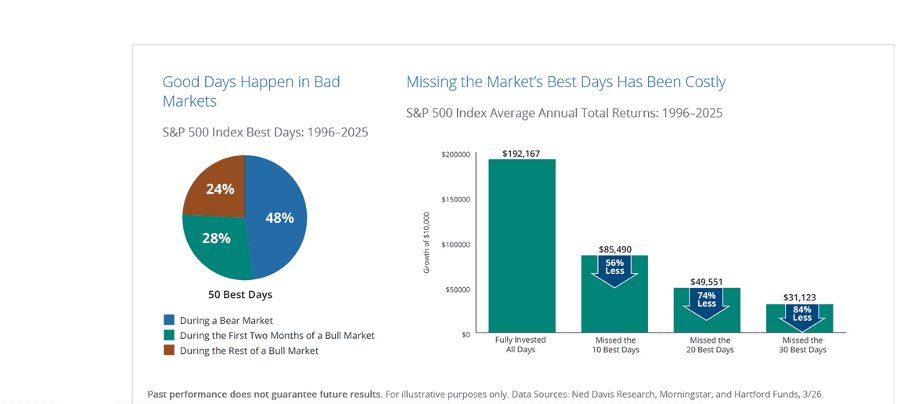
Before we dive into the mechanics of corrections, take a hard look at the chart below. It tells you everything you need to know about why panic selling is so dangerous.
Source: Ned Davis Research, Morningstar, and Hartford Funds, 3/26. Past performance does not guarantee future results. For illustrative purposes only.
Two facts jump off the page. First, roughly half of the S&P 500’s best days over the last 30 years happened during a bear market. Another 28% happened in the first two months of the new bull market—before anyone knew the bull had even begun. Second, missing just the 10 best days over that stretch cut your wealth by more than half. Miss the top 30, and you ended up with roughly 84% less money than the investor who simply stayed put.
That’s the cost of getting cute. And that’s the context in which every conversation about market corrections needs to take place.
Correction vs. Bear Market: Know the Difference
Think of a market correction as the less-ugly cousin of the bear market, which is defined as a prolonged downturn of 20% or more. The two are closely related—after all, in order to enter a bear market, the index must first enter a correction.
In lay terms, a correction is what gets investors worried. A bear market is what gets investors to bail out. Both are products of fear. And long-term results are built on the back of an endless struggle of rallies and pullbacks—ups and downs, over and over.
What Sets a Correction in Motion?
Corrections get set in motion for a variety of reasons. Sometimes a technical trading signal triggers a wave of program trades that sell simultaneously – in those cases, markets may rebound quickly. Sometimes capital rotates from one geography to another (think U.S. to Emerging Markets, or vice versa), or from one asset class to another (stocks to bonds, or vice versa).
Other times, valuations get lofty, the growth that had been expected fails to materialize, and markets are forced to adjust. Or, some piece of bad news or an ominous event hits the headlines, and soon the markets are overwhelmed with negativity. Whatever the cause, these painful episodes are typically short-lived.
The Numbers Behind the Pain
Since 1970, there have been 22 stock market corrections (for the S&P 500) and 7 bear markets, for a combined total of 29 major down-market events. That works out to a correction roughly every 1 in 3 years, and a bear market roughly every 1 in 8 years. Put simply, corrections are about 2-3 times more common than bear markets:
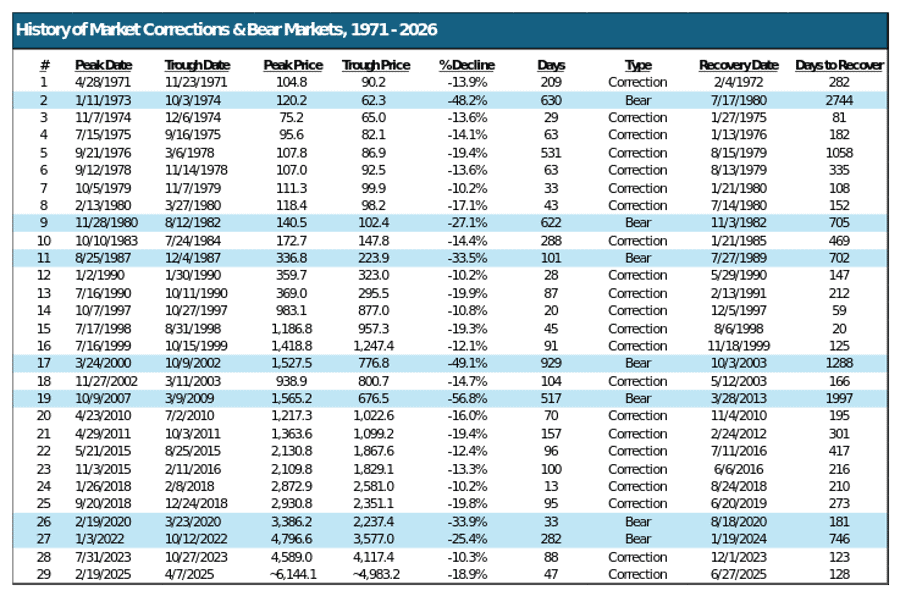
History of Market Corrections & Bear Markets, 1971–2026. Source: Factset.
Corrections last roughly 105 days on average, while bear markets drag on for about 445 days:
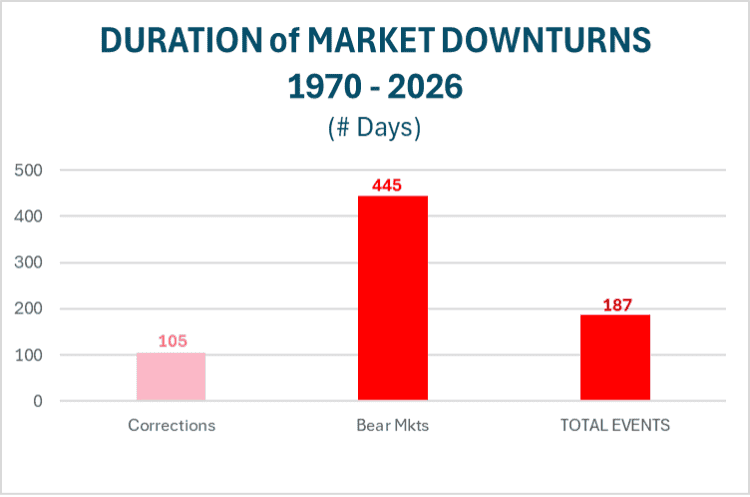
Source: Factset. An index is unmanaged, and you cannot directly invest in an index.
And here’s the most important part: the average correction loses about -14.7%, while the average bear market loses about -39.1%, as the chart below illustrates:
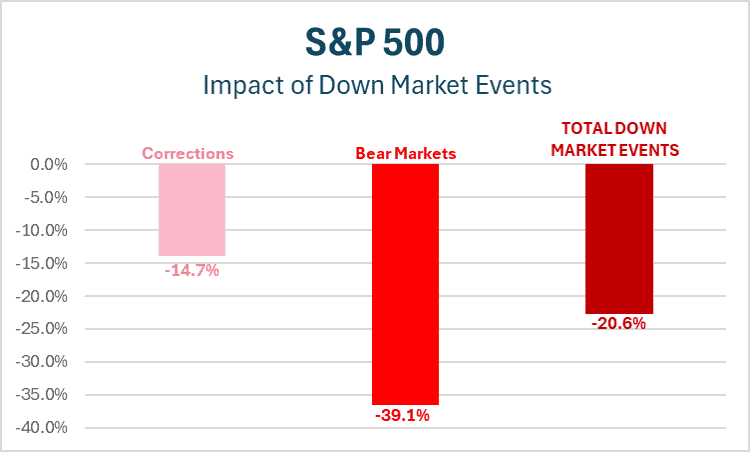
Source: Factset. An index is unmanaged, and you cannot directly invest in an index.
However the market behaves, you always have a choice as an investor: you may sell, stay the course, or buy more. All too often, investors get flushed out by the fear and panic of a down market—accompanied by negative headlines, financial-news programs warning of more pain ahead, and nervous chatter among friends.
But no bell rings to alert you that a recovery has begun. While not a guarantee of future events, what we can do is look at history and see how long recoveries last and how much they produce:
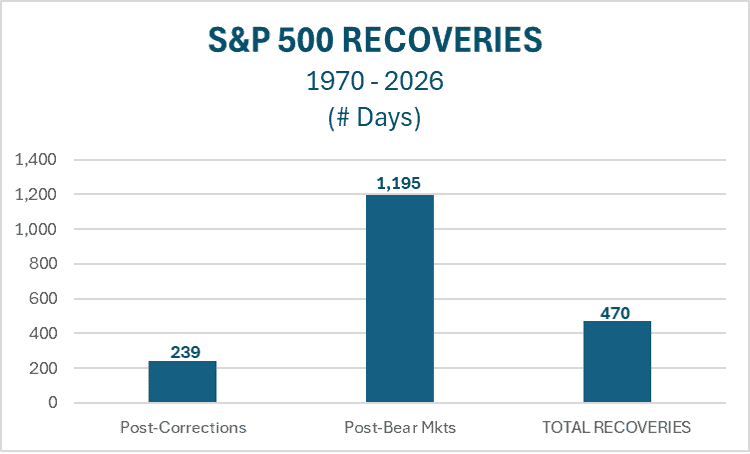
Source: Factset. An index is unmanaged, and you cannot directly invest in an index.
The High Cost of Bailing Out
The investment graveyard is littered with the bones of investors who tried to dodge a correction or bear market—and with those who, midway through one, panicked that it would only get worse. What’s less well understood are the opportunity costs born by those who bail out early but never find the perfect time to get back in. Countless investors have sold into weakness, then compounded the problem by “waiting for the right time” to re-enter—only to miss a doubling or tripling of asset values.
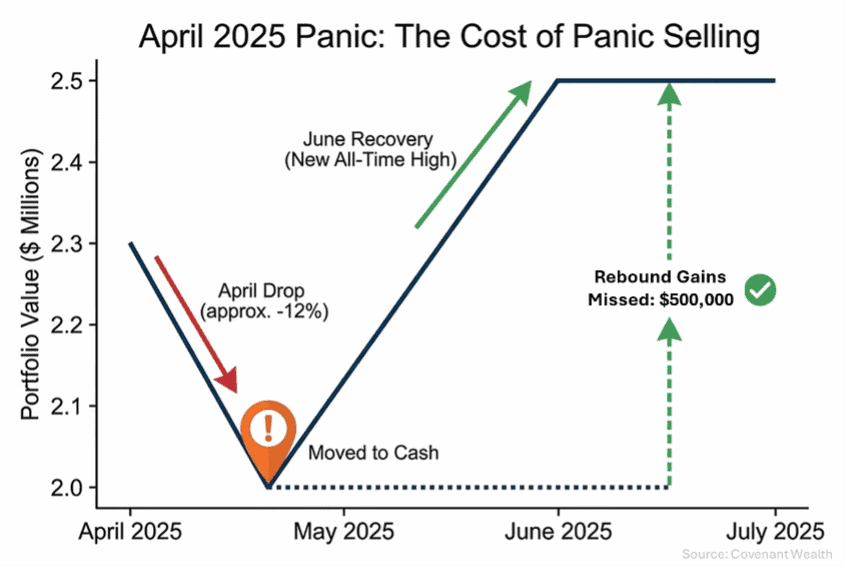
Consider the chart below. It shows the impact of missing out on a rebound after a correction. In this case, the Trump Tariff “Liberation Day” caused a brief market panic in April 2025:
Source: Covenant Wealth
In this example, the investor locked in a (-12%) loss and immediately thereafter missed out on a +25% gain. The net cost of this double-whammy is a whopping $500,000 in a matter of 2.5 months. Trading costs, management fees, tracking error—all of these pale in comparison to the cost of poor investor behavior.
The Myth of Perfect Timing
Of course, there are some people who seem to pull the trigger at just the right time on the way out, and somehow get back in at the right time as well. But a comprehensive examination of the evidence comes up empty. Most of these stories involve people saying something like “it felt right,” or “I just didn’t want to take the pain of another loss,” or “it just felt like the storm had passed.”
None of that is necessarily wrong as a description of how those investors feel. But it does precisely nothing to build a repeatable process for capitalizing on market behavior. In short, none of what these people do is repeatable. And the evidence is left wanting.
Naturally, in an honest examination of markets, all kinds of questions arise. Can the market fall further? Is this time different? If I think the market is heading for a correction or bear market, can’t I just side-step it and get back in when the coast is clear?
Unfortunately, the real world just isn’t that simple. History doesn’t necessarily repeat itself, but it does rhyme. So “this time” is rarely different. Markets unfold as history unfolds, and there is no grand signal to tell us how to interpret events or when to move in or out. Countless investors have tried and failed. On this point, both history and empirical evidence are crystal clear.
Why Staying Invested Wins
Staying invested and living through the ups and downs – consistent with sound financial planning – has been the best approach over the long run. As prices decline, the prospective returns on whatever the future holds just got cheaper, and your forward-looking ROIs just went up. And thanks to dollar-cost averaging, a similar investment buys you more shares. So buying more during a downturn is generally wise.
Remember, the vast majority of companies provide products and services that people need. Whatever fluctuations come to pass, and whichever companies gain market share, somebody, somewhere, must continue to provide us with the things we need.
And there’s one more piece of evidence that bears repeating: when you account for performance with and without just a small handful of high-performing days, investment results are extraordinarily sensitive to those few exceptional sessions. As we showed at the top of this article, roughly half of the best days happen during bear markets, and pulling out due to fear puts you squarely at risk of missing them. That’s a fast way to destroy your chances of compounding at a satisfactory rate.
The Bottom Line
Ultimately, the greatest danger in a correction is not the decline itself – it is the decisions fear convinces us to make. Savvy investors don’t try to outsmart the market’s rhythm. They absorb its lessons: corrections are temporary, bear markets are rare, and time in the market has consistently beaten attempts to time the market.
The path to lasting wealth isn’t found in perfect timing. It’s found in disciplined patience and an unshakable belief in the long-term merits of the businesses you own. Those who master that mindset don’t just survive corrections – they eventually come to see them as the necessary price of admission.
Related Articles

How Quality of the Portfolio Impacts Down Market Recovery and Compounding
Investment Principles,
Top Investment Principles FAQs,
January 15, 2025
Common Investment Mistakes Affluent Investors Should Avoid
Investment Principles,
Personal Finance,
Top Investor Mistakes,
October 1, 2024

Investing Through War: Why History Rewards Discipline Over Fear
Investment Principles,
March 13, 2026