


If you’ve watched enough disaster movies, you know the drill: a crisis hits and characters make a series of poor decisions driven largely by panic.
Markets work the same way, minus the hero trying to save the world in a nick of time.
The Strait of Hormuz is closed. Oil prices have rocketed upward. Financial headlines are doing what they do best — screaming. And somewhere, an investor is about to do something they’ll regret.
Energy supply disruptions can feel cataclysmic while you’re living through them. They dominate the news cycle. They push and pull markets. They cast doubt on economic growth and can apply upward pressure to inflation.
The concern is understandable. Energy is the economy’s circulatory system. If it’s disrupted, it impacts everything downstream. But, and this is worth remembering when you review your accounts, this isn’t humanity’s first energy crisis. It’s not even close. We’ve lived through oil embargoes, revolutions, wars, and supply shocks that made today’s headlines look tame by comparison.
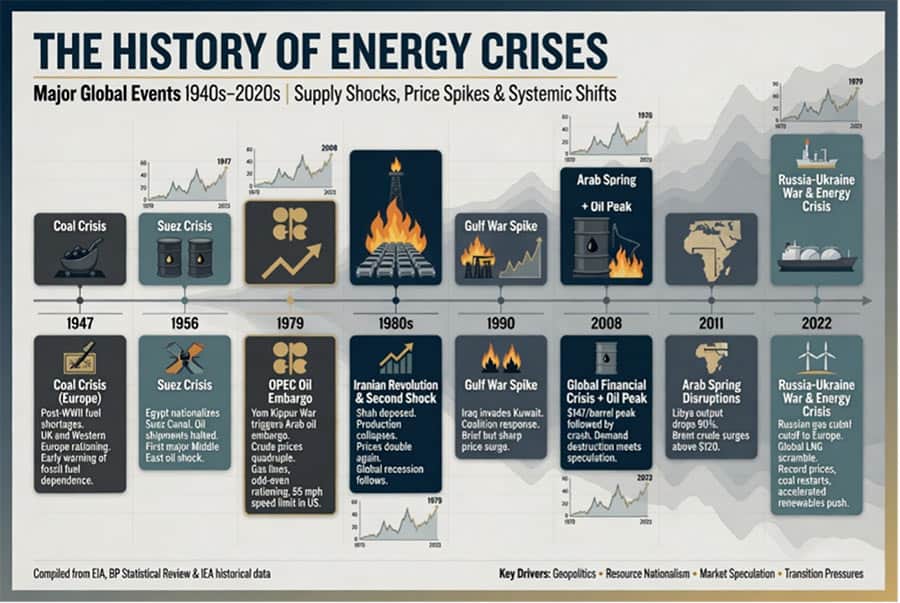
And in every single case, markets eventually recovered.
The investors who came out ahead were the ones who stuck to their plans and resisted the very human urge to do something drastic. Let’s walk through several energy crises and see what separates disciplined investing from panic-selling.
Historical Energy Crises: A Pattern of Disruption and Recovery
1973 Oil Embargo
In October 1973, Arab members of OPEC imposed an oil embargo against the United States following the Yom Kippur War. Oil prices quadrupled. Gas stations everywhere posted “No Gas” signs. Inflation surged.
The S&P 500 plummeted more than 40% by mid-1974, and the economy entered a deep recession. It took six painful years for the market to return to breakeven by 1979. Some investors gave up on equities altogether during this period.
That decision proved costly. Those who abandoned stocks in the 1970s missed the substantial gains of the 1980s and beyond. Investors who stayed the course, despite the volatility, were eventually rewarded over time.
1979 Iranian Revolution and 1980s Iran-Iraq War
The Iranian Revolution in 1979 collapsed oil production in Iran, removing roughly 5 million barrels per day from global markets. Within a year, prices rose from $13 to $34 per barrel. The Iran-Iraq War that followed in 1980 extended the supply disruption for years.
The US entered another recession. Fed Chairman Paul Volcker drove interest rates to 20% to break the inflation spiral. If you think today’s monetary policy is aggressive, go read about Volcker. The man didn’t flinch.
Yet by mid-decade, oil prices had declined significantly as production shifted and demand adjusted. Crisis resolved. Growth resumed. Markets moved on.
1990 Gulf War
Iraq’s invasion of Kuwait in August 1990 removed more than 4.3 million barrels per day from the market. Oil prices jumped from $15 to $42 per barrel in just two months.
The S&P 500 fell roughly 16% over a three-month period. Recession fears overtook headlines. Investors worried about a prolonged conflict and sustained high energy prices.
The acute phase lasted about six months. Once the conflict was resolved in early 1991, oil prices retreated quickly. The market recovered within a year, and the 1990s bull market followed.
2008 Oil Price Spike
In 2008, a combination of strong global demand, a weak dollar, and speculation drove oil prices to $147 per barrel — a record high at the time.
The spike contributed to inflationary pressures and consumer stress, though the financial crisis was the primary driver of that year’s market decline. By the end of 2008, oil had collapsed to almost $30 per barrel.
Prices eventually stabilized in the $60-$100 range through the 2010s. The lesson: not all price spikes are supply disruptions. Demand dynamics and speculation can foster volatility.
2022 Russia-Ukraine War
Sanctions on Russian oil following the invasion of Ukraine led to a European energy crisis. Oil briefly topped $120 per barrel. Natural gas prices in Europe skyrocketed.
Markets were volatile for several months, but alternative supplies emerged. Europe diversified its energy sources. Oil prices settled back to the $70-$90 range within a year.
The common pattern across these crises is that markets initially overreact, pricing in worst-case scenarios. Then supply adapts as producers ramp up output from other sources and conservation measures take effect. Demand responds to higher prices through reduced consumption and improved efficiency. Governments intervene with strategic reserve releases or diplomatic solutions. Eventually, prices normalize and markets recover.
Energy disruptions prompt short-to-medium term volatility, but they rarely upend long-term economic growth or market performance.
Behavioral Mistakes Investors Make During Crises
Panic Selling – Human nature is hard to resist. If every major news outlet is fearmongering, the instinct to “do something” is innate. But selling during peak fear locks in losses and can preclude you from participating in the recovery.
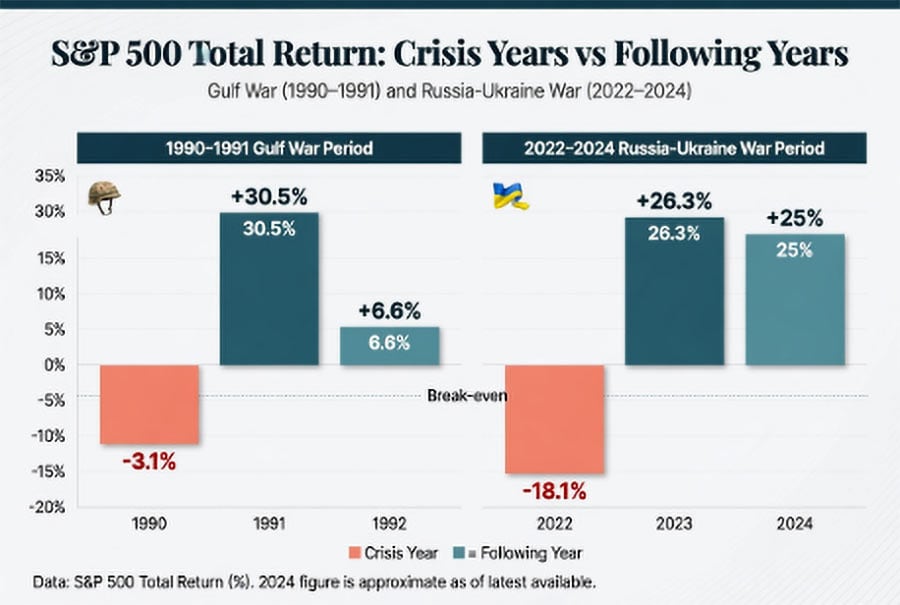
The trap: emotions can override rational assessment. Fear elicits urgency, but markets typically recover amidst the fear, not once it fades.
Headline Chasing and Tactical Repositioning – Attempting to time the market based on energy news is a guessing game. By the time headlines hit, markets have generally priced in much of the information.
Constant repositioning generates transaction costs, potential tax consequences, and the very real risk of being out of the market once it rebounds. The best days often follow the worst days in close succession, which is evident once you consider the broader context of the market during the top investing days of the last three decades.
Top 10 Investing Days in Last 30 years
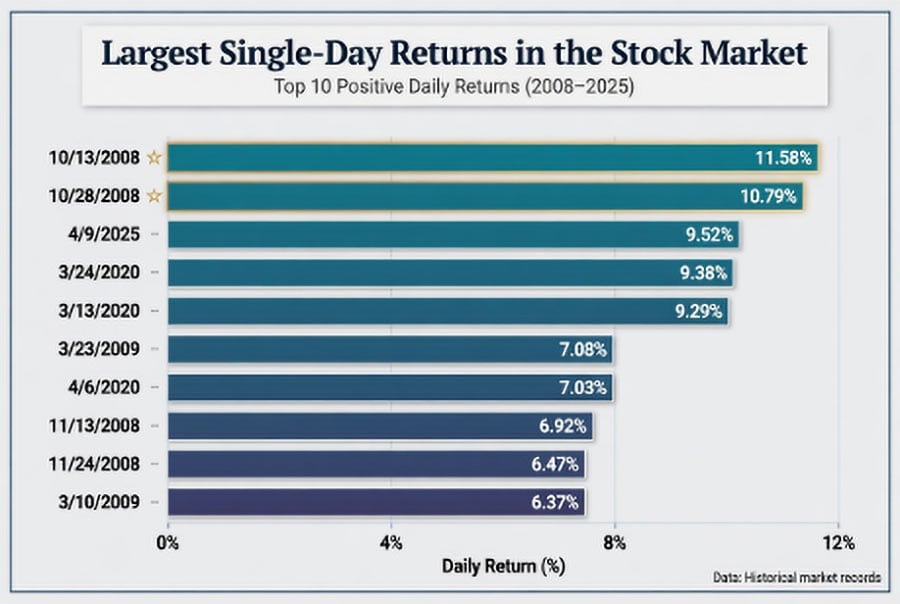
The trap: feeling like you need to “do something” when disciplined patience is the better strategy.
Overconcentration in Energy Stocks – Some investors overweight energy stocks during crises, expecting a sustained period of high prices. While energy companies can benefit from price spikes, the sector is volatile and concentration adds risk.
Energy prices don’t stay elevated indefinitely. Once they normalize, concentrated positions can underperform.
The trap: recency bias — assuming current conditions will persist longer than they actually do.
Abandoning Long-Term Asset Allocation – Shifting from stocks to cash or bonds during energy-driven volatility might feel safe, but it can backfire. During periods of volatility, one in four investors tend to act upon their loss aversion and panic-sell their investments.
The trap: confusing short-term disruption with long-term structural change.
The Power of Staying Invested – It may help to frame the reward of patience in a dollar context: While past performance is no guarantee of success, $10,000 invested in the S&P 500 at the beginning of 1973 — right as the oil embargo hit — would have grown to over $2.3 million by 2026, assuming reinvested dividends.
That’s a 10.8% annual return despite living through the 1973 oil embargo, the 1979 Iranian Revolution, the 1990 Gulf War, the 2008 oil spike, and the 2022 Russia-Ukraine energy shock. Not to mention the other non-energy crashes.
The chances of the market being down on any given day is just below 50%. Like betting on red or black at a roulette table. The probability of negative returns over a 10-year stretch is a mere 6%.
Time is the investor’s best defense against panic.
Investor Takeaways:
- Energy disruptions have occurred repeatedly throughout history. Markets have recovered from all of them, often faster than investors expected.
- Short-term volatility is normal and uncomfortable. Long-term portfolio potential remains intact for disciplined investors who stay focused on their goals.
- Behavioral mistakes, like panic selling, headline chasing, or tactical repositioning, tend to harm returns more than the crises themselves. Investors who stay invested through volatility typically outperform those who try to time exits and re-entries.
- Balanced portfolios built for full market cycles are designed to weather disruptions like the current Strait of Hormuz closure. Diversification, proper asset allocation, and a long-term perspective can be your advantages.
Related Articles

Rose Colored Glasses: Why Investing During the Good Times Can Create Poor Allocation Tilts
Investment Principles,
Top Investor Mistakes,
March 6, 2025

Investing Through War: Why History Rewards Discipline Over Fear
Investment Principles,
March 13, 2026

Common Investment Mistakes Affluent Investors Should Avoid
Investment Principles,
Personal Finance,
Top Investor Mistakes,
October 1, 2024