

No single blow kills the typical retail portfolio. There is no dramatic headline, no one bad decision an investor can point to years later and say, that was the mistake. Instead, the damage is done quietly, a fraction of a percent at a time — a fee here, a forced trade there, a moment of chasing at exactly the wrong point in the cycle. Each cut looks harmless on its own. Compounded over a full market cycle, together they can be the difference between a portfolio that meets its goals and one that never quite gets there.
The traditional retail portfolio — a collection of pooled mutual funds and ETFs, often assembled around whatever has been performing lately — is unusually exposed to these cuts. Some are structural: they are built into the products themselves and bleed return no matter how patient the investor is. Others are behavioral: self-inflicted wounds that the product structure quietly encourages. Below, we walk through both kinds — and why the antidote is the same discipline we return to again and again: own quality, own it directly, keep costs low, and participate in markets rather than trying to predict them.
Part One: The Structural Cuts — Built Into the Product
Cut #1: Herding — How other people’s behavior becomes your cost. When you own a pooled fund, you do not own the securities inside it — you share a vehicle with thousands of other investors, and their behavior rides along with your money. When markets fall and nervous shareholders redeem, the fund must sell securities to raise cash, often at the worst possible prices. You did not sell. You did not panic. But you were there for the ride, and the costs and realized gains from that forced selling land in your account anyway. Managers also hold cash stockpiles to fund redemptions — cash that earns little, yet is still charged the full expense ratio. In a pooled product, the herd’s stampede tramples the patient investor too.
Cut #2: No screen for quality — and what that does to compounding. Most traditional index products select holdings by size, not health. No effort is made to screen out companies with weak or deteriorating earnings, so the unhealthy ride alongside the strong. This matters most in down markets and, just as importantly, in the recoveries that follow. The arithmetic of compounding is unforgiving: a portfolio that falls 30% must gain roughly 43% just to break even, and a 50% decline requires a 100% recovery. Lower-quality holdings tend to fall further in declines and recover more slowly afterward — which means deeper holes and longer climbs. Over a full market cycle, the quality of what you own is not a detail; it is one of the primary drivers of what you actually compound.
Cut #3: The pricing disadvantages of pooled bonds. Bond funds carry their own quiet cuts. Funds trade bonds in large institutional blocks, often at wider spreads than a well-executed individual purchase. Portfolios inside the fund may hold bonds bought at premiums, effectively diluting what new investors receive for their money. And in stressed markets, funds can be forced to sell less-liquid bonds at discounts — or the fund itself can trade at a discount to its net asset value — meaning investors may never realize the full value of what they thought they owned.
Cut #4: Yields you never chose. When you buy a bond fund, you inherit a portfolio of yields-to-maturity that someone else assembled, at prices set in a different rate environment. If the pool is stuffed with low-coupon bonds purchased when rates were lower, you own that low income stream whether it suits your needs or not — and unlike an individual bond, a fund never matures. There is no date on which you are made whole at par. An investor who owns bonds directly chooses each yield, each maturity, and each credit — and can hold to maturity, collecting exactly what was promised on day one.
Cut #5: The trading costs you never see. Expense ratios are disclosed in bold print. Internal trading costs are not. Every rebalance, every index reconstitution, every redemption forces the fund to trade — and every trade carries commissions and bid-ask spreads that are deducted from performance without ever appearing on a statement. Academic research reviewed in U.S. News found these internal trading costs averaged roughly 1.44% per year across mutual funds — in some cases more than the disclosed expense ratio itself. A buy-and-hold investor cannot avoid these costs, because the fund never stops trading on their behalf.
Cut #6: The product wrapper itself. Step back and the first five cuts share a common source: the wrapper. A pooled product places a structure — and a fee-earning intermediary — between the investor and the businesses they actually own. Direct ownership of individual stocks and bonds removes that layer. The direct owner controls what is held, when it is sold, how taxes are managed, and what quality standard every position must meet. No embedded capital gains from strangers’ redemptions. No cash drag. No inherited yields. The question worth asking is simple: are you investing in companies, or in products that contain them?
Part Two: The Behavioral Cuts — Self-Inflicted, Product-Encouraged
Cut #7: Chasing what has already happened. Returns are a historical event — they belong to the investors who owned the asset before the rally, not to those arriving after the headlines. Yet the retail pattern repeats in every cycle: money floods into whatever just performed, which usually means buying near the end of a move rather than the beginning. The disciplined investor does the opposite — looking for quality trading at a discount, where the recovery is still ahead, rather than paying full price for a story that has already been told. You cannot buy yesterday’s return. You can only buy tomorrow’s price.
Cut #8: Catching the end of the cycle, not the beginning. Chasing returns carries a second, sharper edge: the things investors chase are, almost by definition, the things that have become expensive. Buying an asset after a long run means accepting the risk that most of the cycle is behind it — and overvalued assets tend to fall hardest when sentiment turns. The investor who repeatedly catches the last leg of each rally, then absorbs the full weight of each correction, can underperform dramatically — even while owning “winning” funds the whole time. The cut is not in the product’s return; it is in the gap between the fund’s return and the investor’s.
Cut #9: Buying hype, not earnings. Every era produces companies that are famous before they are profitable — hot IPOs, concept stocks, sectors promising a “new economy.” History’s lesson, from the dot-com bubble forward, is consistent: when the story replaces the earnings, the eventual reckoning is severe. A great company is not always a great investment, and a company with no earnings is rarely either. At the end of the day — earnings matter. Portfolios anchored to businesses with real, durable profits do not need the story to come true; they are paid by results that already exist.
Cut #10: No complementing sectors. Finally, chasing has a portfolio-level consequence: concentration. A collection of funds bought because each was recently hot is not diversification — it is the same bet repeated in different wrappers. A properly balanced portfolio holds complementary sectors and asset classes on purpose, so that something generally is participating in leadership while nothing can decimate the whole. It will never feel as exciting as the hottest fund of the moment. It is also never on the wrong side of the whole market at once — and over a full cycle, that is where consistent compounding comes from.
Adding Up the Cuts
Individually, none of these numbers alarms anyone — that is precisely why they persist. But return is a finite resource, and every layer takes its share before the investor receives theirs. The illustration below shows how a hypothetical market return can be whittled down as the structural and behavioral cuts stack on top of one another.
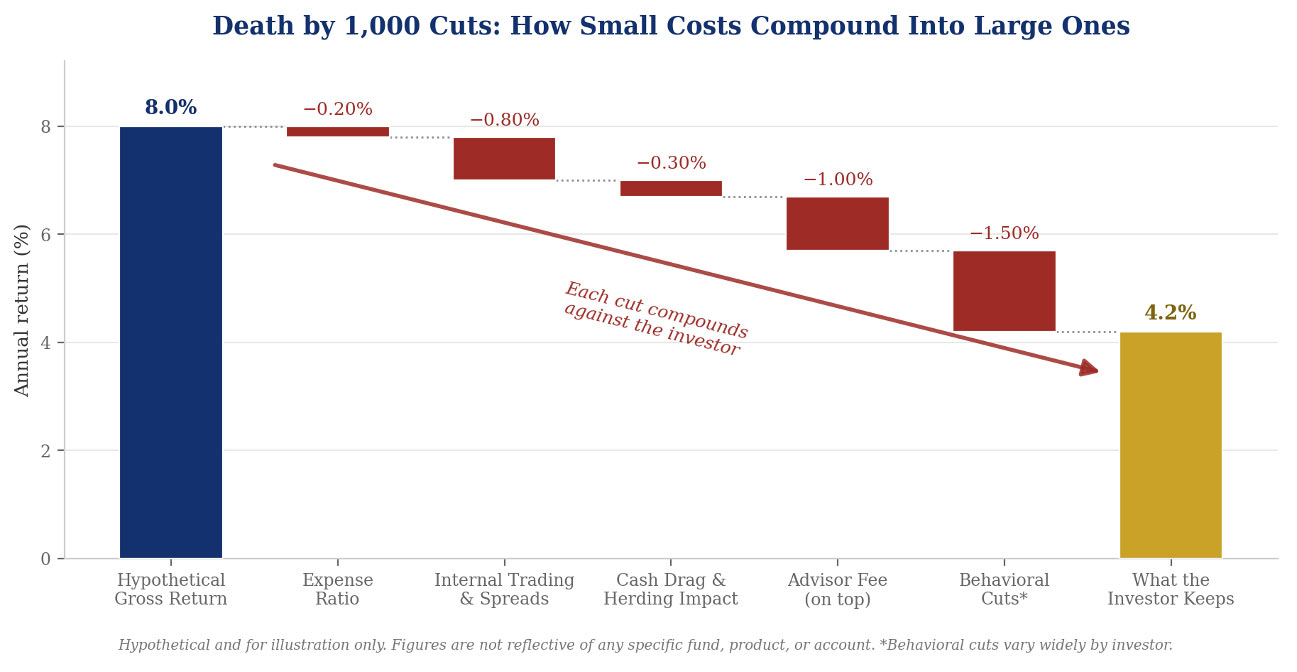
Compound that gap over twenty or thirty years and the arithmetic becomes hard to ignore. Two percentage points of annual drag on a $1 million portfolio, left to compound for twenty-five years, is not a rounding error — it is a meaningful share of the retirement the portfolio was built to fund.
The Disciplined Alternative
The encouraging news is that none of these cuts is mandatory. Each one traces back to a choice — and each has a disciplined alternative:
- Own quality. Screen for earnings strength rather than accepting whatever size alone puts in the index. Quality falls less in declines and recovers faster — the two moments that matter most to compounding.
- Own shares directly. Direct ownership of individual stocks and bonds removes the wrapper — and with it the herding impacts, embedded gains, cash drag, inherited yields, and hidden trading costs of pooled products.
- Eliminate the hidden costs. What is disclosed is only part of what is charged. Insist on knowing the all-in cost of ownership, not just the expense ratio.
- Participate rather than predict. Stop chasing what has already happened. Stay balanced across complementary sectors, invest where value waits rather than where headlines point, and let the full market cycle do its work.
Death by a thousand cuts is only fatal if the cuts go unaddressed. Seen clearly, each is avoidable — and avoiding them requires no forecast, no perfect timing, and no heroics. Just discipline, quality, and direct ownership, applied patiently over a full market cycle. Stay the course.
Sources & Disclosures
Internal mutual fund trading cost figure (1.44% average) as reviewed in Silverblatt, Rob. “How Mutual Fund Trading Costs Hurt Your Bottom Line.” U.S. News & World Report, 12 Mar. 2013, summarizing academic research from the University of California, the University of Virginia, and Virginia Tech. Cost illustration is hypothetical and for educational purposes only; figures are not reflective of any specific fund, product, or account. This material is for educational purposes only and does not constitute investment, tax, or legal advice or a recommendation to buy or sell any security. Past performance is no guarantee of future results. Investing involves risk, including the possible loss of principal.