



Why the rising generation of wealth holders is rethinking the “set-it-and-forget-it” index fund — and what earnings-focused direct indexing offers instead.
A New Generation Meets an Old Default
The largest wealth transfer in history is now underway. Research firm Cerulli projects that roughly $124 trillion will change hands through 2048, with close to $100 trillion of it passing from Baby Boomers and older generations to Gen X and Millennial heirs. The affluent investors inheriting and building this wealth tend to be tech-native, fee-aware, tax-conscious, and far more insistent on transparency and control than the generation before them. Tellingly, surveys find that more than 70% of heirs change or drop the advisor who managed the family money once they take the reins.
This generation has been taught one lesson above all others: the low-cost, passive, market-cap index fund is the obvious “smart” default. For years that was a reasonable rule of thumb. But two things have quietly changed. First, the index itself has become a concentrated bet rather than a broad diversifier. Second, the pooled fund wrapper carries costs and constraints that sit squarely at odds with what the next generation actually wants. There is a better-fit approach for investors with the asset base to use it: earnings-focused direct indexing.
The “Index” Isn’t the Diversifier It Used to Be
A market-cap-weighted index assigns each company a weight based on its size — the bigger the company, the bigger the position. By construction, that means the index automatically buys more of whatever has already gone up, and trims whatever has lagged. It is, in effect, a momentum machine dressed up as diversification.
The result has been a historic concentration. Data from RBC Wealth Management and FactSet show the ten largest companies swelled to roughly 41% of the S&P 500’s total weight at the end of 2025 — about double the ~19% of a decade earlier, and the most concentrated the index has ever been. For perspective, the index’s cyclically adjusted price-to-earnings ratio recently sat near 40, a level previously seen only around 1929 and 2000.
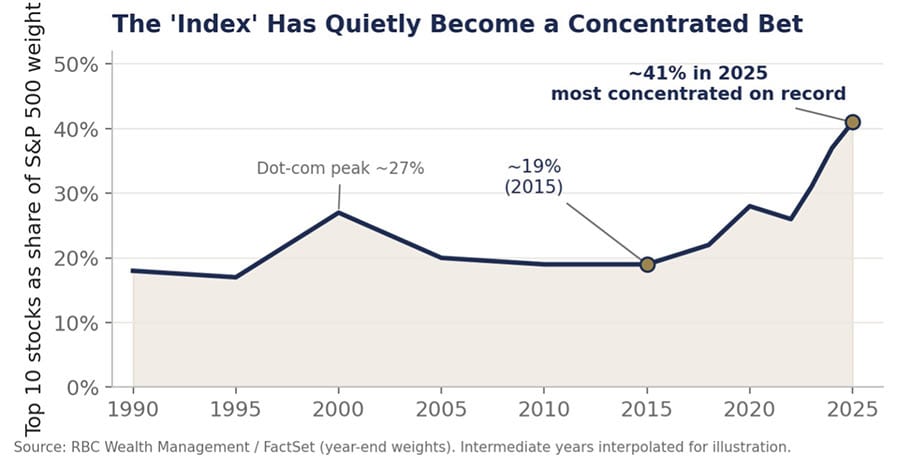
A “500-stock” fund increasingly behaves like a handful of mega-cap technology bets.
Concentration alone might be tolerable if those giants were carrying their weight in profits. They are not, at least not in proportion to their price. The same ten names that command ~41% of the index’s weight generate only around 32% of its earnings — a gap of roughly nine percentage points between what investors are paying for and what those businesses actually earn. Price has outrun profit.
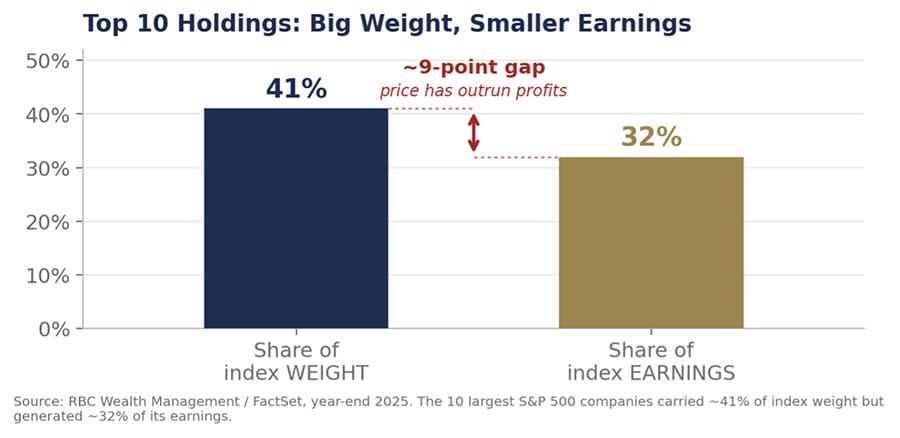
When market value runs well ahead of earnings, the foundation gets fragile. Source: RBC / FactSet, year-end 2025.
This matters for returns, not just optics. Goldman Sachs research has found that elevated concentration has historically preceded materially weaker S&P 500 returns over the following decade. The next generation is being handed an “index” that is really a leveraged wager on a few companies — a wager they did not choose and may not want.
Holding the Losers Until It’s Too Late
There is a second, quieter flaw in market-cap weighting: it applies no quality screen whatsoever. A passive index includes unhealthy companies for the simple reason that nothing is designed to keep them out. Worse, it tends to hold a deteriorating business all the way down — because a company isn’t removed until its market cap has already collapsed enough to drop it from the index. By then, the damage is done and the loss is locked in.
The history is unambiguous. Enron and Lehman Brothers sat in the index until they were nearly worthless. AutoNation fell roughly 31% before being removed from the S&P 500 in 2017 — and then went on to recover and more than double in the years that followed. Index investors absorbed the decline and missed the rebound. Selecting holdings on size alone is not due diligence; it is the absence of it. An earnings-focused approach screens for the strength and consistency of a company’s earnings before it is ever owned.
The Hidden Toll of the Pooled Wrapper
Even if the underlying index were sound, the pooled fund that tracks it adds a layer of friction most investors never see. The expense ratio is only the visible tip. Beneath it sit internal trading costs and bid-ask spreads — a multi-university study cited by U.S. News pegged average mutual fund trading costs near 1.44% a year, and considerably higher for small-cap funds. Then there is cash drag and small-investor herding: when other shareholders pile in or rush out, the fund is forced to trade, and those costs are borne by everyone, no matter how patient you personally are. On top of all of it, an advisory fee of 0.5% to 1.5%+ is often layered over the product’s own fee — two tolls on the same assets.
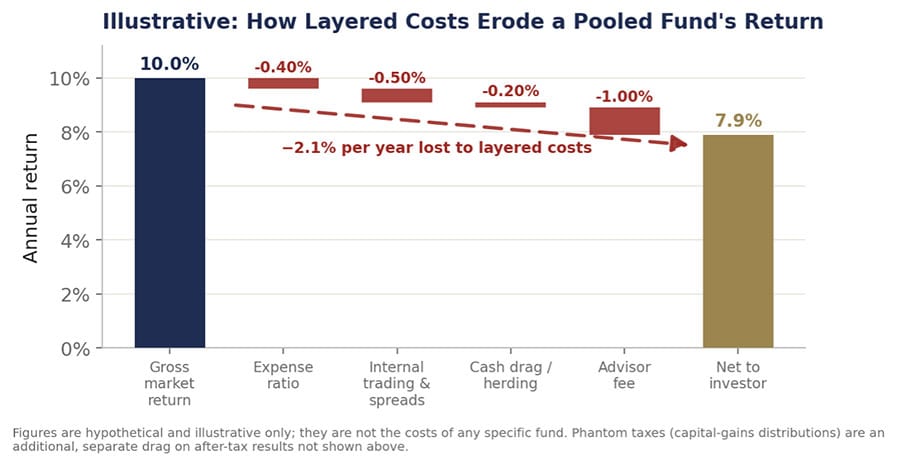
Each layer is modest on its own; together they quietly compound against the investor every year.
Then come the phantom taxes. Because a mutual fund must distribute its realized gains, investors can owe tax on transactions they never made. Morningstar reported that roughly 72% of U.S. equity mutual funds paid capital-gains distributions in 2025, averaging on the order of 7-10% of net asset value. You can be taxed on gains that another shareholder’s redemption forced the fund to realize — even in a year your fund lost money, and even if you only just bought in. It is, as it is often called, a tax on someone else’s exit.
And underlying all of this is a loss of transparency and control. In a pooled fund you do not choose the holdings, you cannot time your own gains, and you cannot exclude what you would rather not own. For a generation that expects to see and shape what it owns, that is a poor fit.
Direct Indexing: Own It, See It, Control It
Direct indexing — also called institutional indexing — simply means owning the individual stocks and bonds directly, rather than buying a pooled fund that holds them on your behalf. That single structural change addresses nearly every shortcoming above at once.
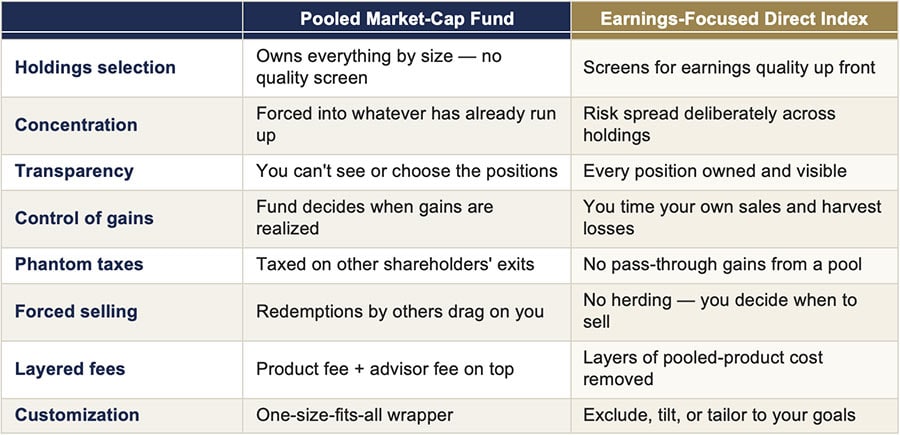
This is precisely why Earnings-Focused Indexes are built on three principles: earnings quality (own businesses with real, consistent profits), direct ownership (full transparency and control, with no phantom taxes or forced herding), and minimizing hidden costs (strip away the layered fees of packaged products). It is indexing for people who would rather understand and shape their portfolio than hand it to a black box.
Built for How the Next Generation Invests
Long-term wealth is driven by three factors of compounding, not one: how much of the market’s upside a portfolio captures, how much of its downside it avoids, and how quickly it recovers afterward. That last factor is probably the most underappreciated — because the math of recovery is brutal.
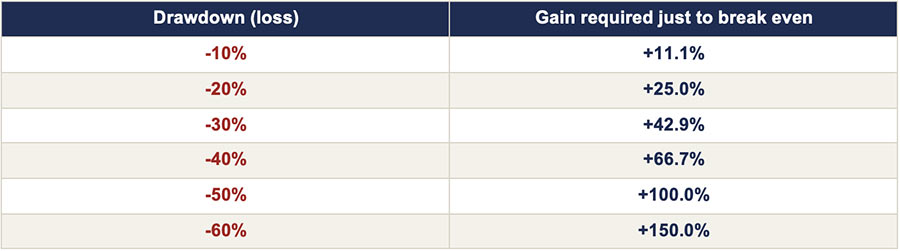
A portfolio that falls 50% needs a 100% gain just to get back to even, and every month spent climbing out of a hole is a month not compounding. High-quality companies tend to fall less and recover faster, which is exactly why a quality screen matters more than a size screen. Direct ownership helps compound that advantage by letting investors avoid forced selling and manage taxes on their own timeline.
Put it together and the fit is hard to miss. A rising generation of affluent investors want control over what they own, transparency into every position, tax efficiency they can actually manage, the freedom to align holdings with their values, and an escape from concentration they never signed up for. Earnings-focused direct indexing delivers all five. “Set it and forget it” is giving way to “own it and shape it.”
The Bottom Line
The default isn’t always the smart choice. The passive, market-cap index fund made sense in a simpler era, but today it bundles record concentration, no quality control, a stack of hidden costs, phantom taxes, and a near-total loss of transparency — the very things the next generation of wealth holders is least willing to accept. For affluent investors with the asset base to own securities directly, earnings-focused direct indexing offers a more transparent, tax-aware, and quality-driven way to participate in the market’s long-term compounding.
Related Articles

Not All Market Cap Indexes Are Equal
Index Investing,
December 12, 2025

Should Affluent Investors Invest in Index Funds?
Index Investing,
Indexing for the Affluent,
Top Index FAQs,
October 21, 2024

4 Critical Impacts of an Inefficient Portfolio
Investment Principles,
Portfolio Considerations,
January 8, 2025