



By Indexopedia Research Team | August 9, 2024 | In
When you buy shares of a publicly traded company, you become a shareholder and acquire a stake in the company’s ownership. As a shareholder, you hold certain rights, including the ability to vote on significant matters that influence the company’s future. But what if you own the shares through an investment in a mutual fund? You might be surprised to learn that when you own shares of a company through a mutual fund, the fund manager, not you, owns the rights to vote the shares.
What is a Proxy?
A proxy is an individual or organization appointed by a shareholder to vote on their behalf at a company’s annual or special meeting. Proxies can be anyone the shareholder trusts, such as a family member, friend, financial advisor, or even a professional proxy solicitation firm. The process of appointing a proxy is typically facilitated through a proxy statement, which is distributed to shareholders before the meeting.
Rights and Responsibilities of Shareholders
Shareholder voting is a vital mechanism that allows shareholders to participate in the decision-making process of the company. Key decisions made through shareholder voting include:
- Electing Board Members:
- Shareholders vote to elect members to the company’s board of directors. These directors are responsible for overseeing the company’s management and making significant business decisions. For example, in 2020, shareholders of Disney voted to elect several board members who would guide the company through the challenges posed by the COVID-19 pandemic.
- Approving Executive Compensation:
- Shareholders have the right to approve or disapprove executive compensation packages. This includes salaries, bonuses, and stock options awarded to top executives. In 2018, Tesla shareholders voted on CEO Elon Musk’s compensation package, which tied his pay to ambitious performance targets.
- Amending Company Bylaws:
- Shareholders can vote on changes to the company’s bylaws, which govern how the company operates. For instance, in 2019, Google’s parent company, Alphabet, sought shareholder approval to amend its bylaws to improve governance practices.
Each share typically carries one vote, though some companies have different classes of shares with varying voting rights. For example, Alphabet has Class A shares with one vote per share and Class B shares with ten votes per share, giving founders and insiders greater control.
Methods of Proxy Voting
Shareholders who cannot attend meetings in person can vote by proxy. Proxy voting can be executed through various methods:
- Mail:
- Shareholders receive a proxy card in the mail, which they fill out and return to the company. This traditional method remains popular among those who prefer paper documentation.
 Online:
- Many companies offer online voting platforms, allowing shareholders to cast their votes conveniently from anywhere. This method is becoming increasingly prevalent due to its ease and accessibility.
- Phone:
- Some companies provide a telephone voting option, where shareholders can follow prompts to submit their votes.
Shareholders can give their proxy explicit instructions on how to vote on specific issues, ensuring their preferences are honored. Alternatively, they can grant their proxy discretionary authority to vote as they see fit, trusting the proxy to make decisions in their best interest.
Importance and Impact of Proxy Voting
Proxy voting is a crucial tool for shareholders who cannot attend meetings in person. It ensures that their votes are counted and their voices heard. By appointing a proxy, shareholders can participate in critical decisions affecting the company’s direction and governance.
Moreover, proxy voting promotes transparency and accountability in corporate governance. It allows shareholders to influence management decisions and hold the company accountable for its actions. For example, in 2019, ExxonMobil shareholders used their proxy votes to push for greater disclosure of the company’s climate change risks.
Drawbacks for Mutual Fund and ETF Investors
One important aspect of proxy voting that investors often overlook is that the ability to vote proxies is generally available only to those who own shares directly. When investors purchase shares through pooled investment vehicles like mutual funds or ETFs, the voting power is transferred to the fund company, which votes on behalf of all the investors. This means individual investors in these funds have no direct say in the proxy voting process.
For investors who prioritize having a direct voice in corporate governance, direct indexing is an alternative to mutual funds or ETFs. Direct indexing allows investors to hold individual stocks and vote their shares directly, thus maintaining their proxy power.
There have been times when the objectives of the fund company and their shareholders have not been completely aligned. In fact, this happens fairly regularly. The following examples illustrate how this misalignment often causes friction between the investors and fund management:
- ExxonMobil Climate Change Proposals (2021)
- Event: In 2021, there were significant shareholder proposals at ExxonMobil regarding the company’s climate change policies and the election of directors who would support more aggressive climate action.
- Fund Company Action: Vanguard, a major shareholder, voted in favor of adding new directors proposed by an activist hedge fund, Engine No. 1, which sought to push ExxonMobil towards a more sustainable future.
- Client Disagreement: Some individual Vanguard clients disagreed with this decision, believing that such activist interventions might destabilize the company and negatively impact its short-term performance. They preferred a more traditional approach focusing on oil and gas profits.
- Facebook’s Dual-Class Share Structure (2017)
- Event: In 2017, there was a shareholder proposal to eliminate Facebook’s dual-class share structure, which grants disproportionate voting power to its founder, Mark Zuckerberg, and a small group of insiders.
- Fund Company Action: BlackRock, a significant institutional investor, voted against the proposal to maintain the dual-class structure, aligning with management’s stance.
- Client Disagreement: Some BlackRock clients were in favor of the proposal, arguing that eliminating the dual-class structure would enhance corporate governance and accountability. They felt their interests were not adequately represented by BlackRock’s vote.
- Apple’s Executive Compensation (2020)
- Event: In 2020, Apple faced a shareholder vote on executive compensation packages, which included substantial stock grants and bonuses for top executives.
- Fund Company Action: Fidelity, as a major shareholder, voted in favor of the proposed executive compensation plan.
- Client Disagreement: Some Fidelity clients opposed the compensation plan, feeling that it was excessively generous and not sufficiently tied to long-term performance metrics. They were concerned about income inequality and the potential misalignment of executive incentives with shareholder interests.
- Tesla’s Director Elections and Compensation (2021)
- Event: In 2021, there were key votes on Tesla’s director elections and executive compensation packages.
- Fund Company Action: State Street Global Advisors (SSGA) voted in favor of the existing board members and the executive compensation package.
- Client Disagreement: Some SSGA clients were dissatisfied with Tesla’s governance and compensation practices, arguing that the board lacked sufficient independence and the compensation packages were overly lucrative. These clients felt that SSGA’s votes did not reflect their concerns about corporate governance and excessive executive pay.
- Amazon’s Environmental and Social Proposals (2022)
- Event: Shareholders at Amazon proposed several environmental and social resolutions, including increased transparency on climate impacts and better labor practices.
- Fund Company Action: T. Rowe Price, a significant Amazon shareholder, voted against many of these proposals, aligning with Amazon’s management.
- Client Disagreement: Numerous T. Rowe Price clients supported these environmental and social proposals, advocating for stronger corporate responsibility and sustainability measures. They felt the fund company’s votes were misaligned with their values and interests.
Many people would be surprised to learn just how much influence the large Institutional players have when it comes to major corporate governance decisions. The table below illustrates the extent of their reach (as of 8/7/2024):
Company | Ticker | Institutional Ownership |
Meta Platforms (Facebook) | META | 79.33% |
Exxon Mobile | XOM | 57.77% |
Apple Inc. | AAPL | 58.25% |
Tesla Inc. | TSLA | 46.05% |
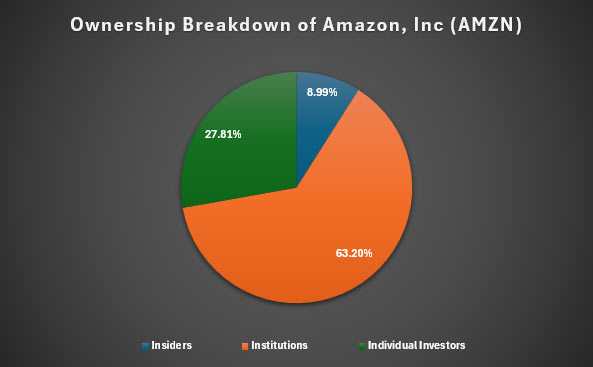
Amazon.com Inc. | AMZN | 63.20% |
The exhibit below illustrates the proportion of ownership of popular online stock, Amazon, Inc (as of 8/7/24):
Conclusion
Shareholder voting and proxies play an essential role in corporate governance. As a shareholder, it is crucial to stay informed about the issues facing the company and exercise your right to vote. If you are unable to attend a meeting in person, appointing a proxy can ensure that your vote is still counted and your voice heard. By doing so, you contribute to the accountability and transparency of the company, ultimately protecting and potentially enhancing your investment.
Related Articles

Who owns the stocks when I invest in index funds?
Index Investing,
Top Index FAQs,
October 16, 2024

Exploring the Different Forms of Index Investing: Mutual Funds, ETFs, and Institutional Indexing
Index Investing,
Top Index FAQs,
Types of Indexes,
September 24, 2024

What is Shareholder and Proxy Voting?
Markets,
Top Markets FAQs,
November 3, 2023