

In the spring of 2026, the financial headlines read like a nonstop emergency broadcast. War in the Middle East. Oil prices surging. Tariff wars rattling supply chains. AI stocks swinging wildly on earnings misses. Recession warnings one week, inflation fears the next. For many investors, the barrage feels relentless. After the seemingly relentless volatility, the emotional toll has a name: investor fatigue.
Investor fatigue is the slow erosion of discipline that happens when negative news becomes the daily soundtrack of the markets. It’s not just stress, it’s a psychological state where constant negativity warps decision-making. Tired investors stop thinking long-term and start reacting in the moment. They sell after prices decline out of fear. Or worse, they chase “hot” stocks trying to “make up for” the poor performers they just sold. Whether out of fear of losses, or desperation to make up lost ground, making choices for the wrong reasons almost invariably leads to disaster.
The result is the same: wealth quietly slips away, not because the markets are broken, but because investor behavior has worsened.
The Psychology Behind the Mistakes
Behavioral finance has documented this pattern for decades. Loss aversion—the well-studied tendency for losses to hurt roughly twice as much as gains feel good—kicks into overdrive during negative news cycles. When every headline screams danger, the brain defaults to self-protection: “Get out now before it gets worse!”
Recency bias compounds the problem. Investors overweight the most recent events and assume the current gloom will persist forever. A string of down days starts to feel like the new normal. FOMO (fear of missing out) then appears in the opposite direction: exhausted from sitting in cash, the investor finally throws money at whatever has been running hottest—often right before it reverses.
We saw this play out in 2025. President Trump’s Tariff announcements on April 2, 2025 triggered sharp sell-offs, prompting retail investors to dump broad-market ETFs at perhaps the worst possible time. Later, when certain AI-related names surged on hype, many who had sold early piled back in at elevated valuations, only to suffer when reality set in. Especially during times of uncertainty, the media acts as a sort of gloomy cheerleader. Well-informed investors know that the steady diet of bad news and fear mongering can trigger emotional responses.
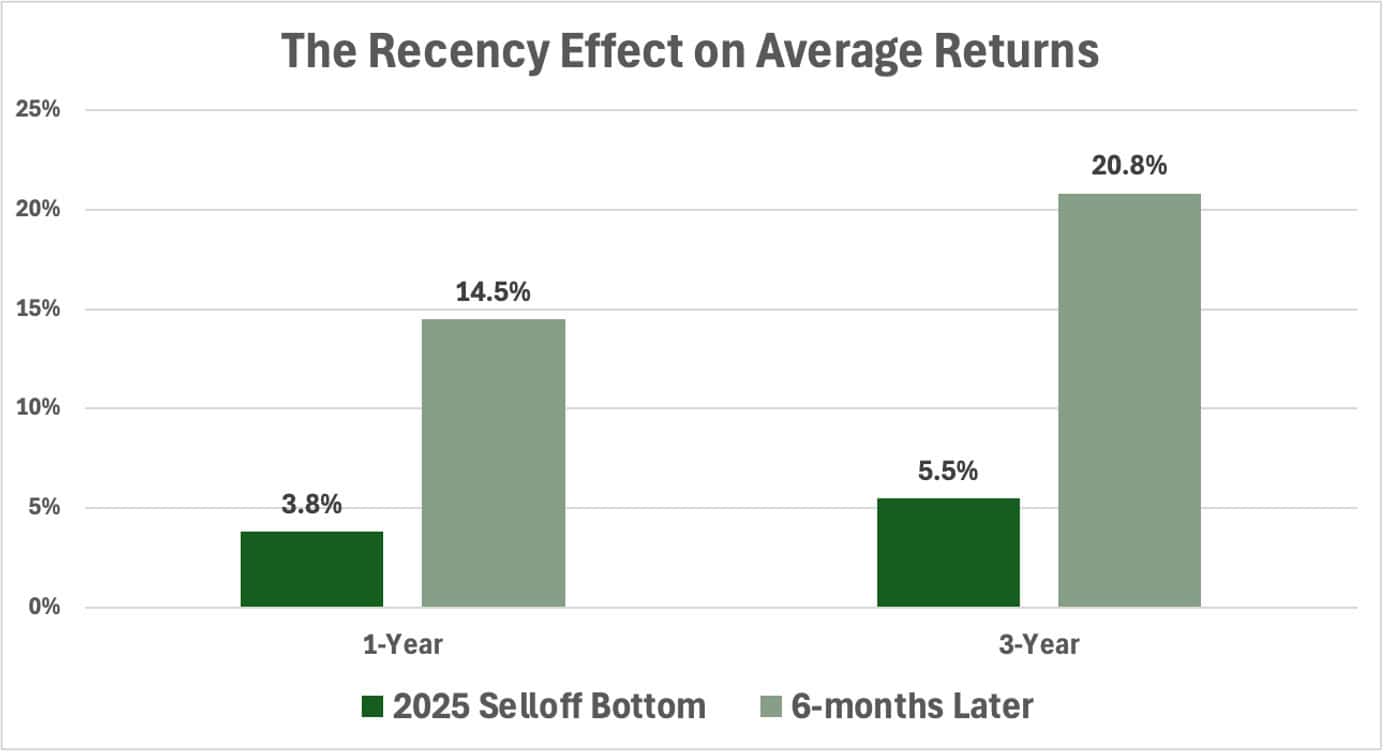
Shortly after the announcement of President Trump’s ‘Liberation Day’ program to enact tariffs on the world, the market miscalculated its impact and declined to what turned out to be its bottom on April 21, 2025. At that point in time, fear was rife and the trailing 1-year and 3-year cumulative returns looked meager. But just 6 months later, on October 22, 2025, the trailing 1-year and 3-year cumulative returns now looked strong due to the market’s massive recovery.
Source: St. Louis Federal Reserve (FRED)
How many investors listened to the media naysayers and erroneous prognosticators, only to lock-in losses and miss out on substantial gains. Or worse, those who become restless from sitting out on the sidelines only to jump in at highs. The pattern is predictable: fear of future catastrophic losses causes premature exits at or near lows; then when the market surges, knee-jerk fear of missing out on a rally causes reckless entries. Both destroy compounding.
The financial cost is staggering. Studies consistently show that the average individual investor underperforms the market by 3-4 percentage points per year largely because of emotionally driven timing mistakes. Over a 30-year career, that “behavior gap” can turn a comfortable retirement into a worrisome one. These seemingly small tweaks in investment behavior can lead to the difference of many millions on ending wealth some time down the road.
But the hidden cost is even greater: the erosion of confidence. Once an investor starts making reactive decisions, it becomes harder to trust any plan at all. The fatigue deepens.
Why News Feeds Exploit Our Weaknesses
Modern media is optimized for attention, not accuracy or balance. Negative stories travel faster and linger longer in our minds (a phenomenon psychologists call negativity bias). Add 24/7 financial television, online trading communities, and algorithm-driven social-media feeds, and the average investor is bombarded with hundreds of fear-inducing data points every week, amplifying the impact.
The result is decision fatigue on steroids. After enough cycles of panic and regret, many investors simply check out—either by moving entirely to cash or by abandoning any semblance of discipline and chasing whatever promises quick relief.
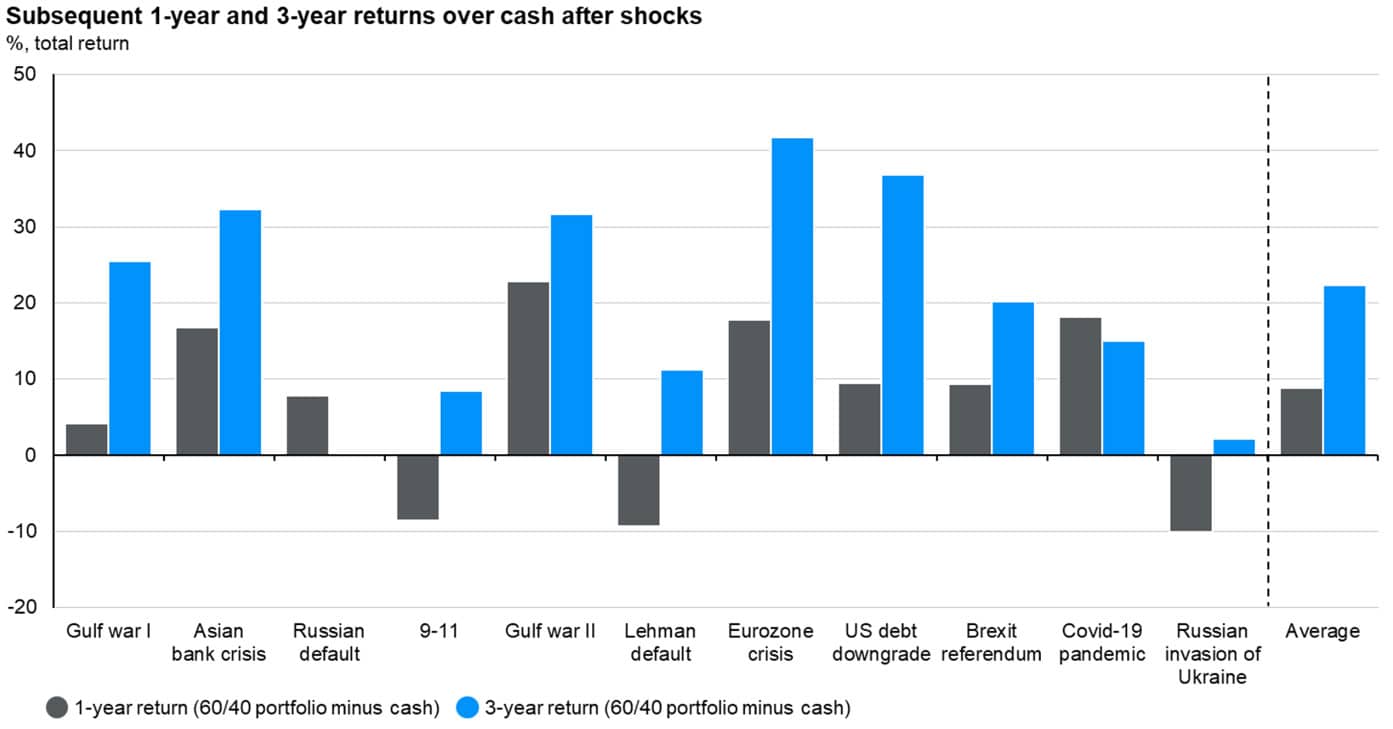
To support this point, the chart below illustrates how returns after economic or geopolitical shocks have been strong, averaging over 20% in the three years post-crisis for a fairly conservative 60/40 portfolio.
Source: JPMorgan Guide to the Markets. https://am.jpmorgan.com/se/en/asset-management/per/insights/market-insights/guide-to-the-markets-new/guide-to-the-markets-slides-europe/investing-principles/gtm-ce-sp500fundflows/
This is exactly the wrong response. Markets have always had seasons of unease. The difference today is the volume and velocity of the noise.
A Better Way: The 7 Pillars of Efficient Portfolio Theory
The antidote to investor fatigue is not to ignore the news entirely. It’s to replace reactive emotion with a clear, repeatable decision framework—one that doesn’t depend on predicting the headlines. The strongest investors rely on seven foundational pillars. These principles act like a compass in foggy weather: they don’t eliminate uncertainty, but they keep you moving in the right direction.
Earnings Quality
Focus on companies that generate genuine, sustainable profits rather than accounting tricks or hype-driven growth. Strong free cash flow and consistent margins provide a margin of safety when the narrative turns negative. When the market panics, high-quality earnings act as ballast.
Spreading Risk
True diversification goes far beyond “stocks and bonds.” It means spreading capital across asset classes, geographies, market caps, and styles so that no single headline can sink the entire portfolio. When one area suffers from negative news, others can often remain stable or even benefit.
Tailored Portfolios
The right mix is the one built around your life, time horizon, cash-flow needs, tax situation, and risk tolerance – not the crowd’s. A personalized portfolio is far easier to stick with when the news cycle screams that “everyone” is doing something else.
Complementary Sectors
Pair sectors that tend to behave differently in various economic environments. Defensive areas (consumer staples, healthcare, utilities) can offset cyclical ones (technology, industrials, financials). This natural balance reduces the urge to make big tactical shifts every time sentiment swings.
Direct Ownership
Owning individual high-quality businesses (or a concentrated basket of them) gives you clarity and conviction that index funds alone cannot provide. When you understand the underlying companies, it’s much easier to tune out short-term noise and focus on long-term value creation.
Control
Retain control over timing, tax consequences, and rebalancing decisions. This includes strategies like tax-loss harvesting, managing capital-gains timing, and avoiding forced selling. Investors who feel in control are far less likely to make emotional moves driven by external headlines.
Yield and Cash Flow
Prioritize assets that produce reliable income—dividends, interest, or cash flow. When your portfolio generates cash regardless of daily price swings, negative news loses much of its emotional power. You’re no longer solely dependent on capital appreciation to feel like you’re “winning.”
Together, these seven pillars create a system that is deliberately boring by design. They shift the focus from trying to outsmart the daily news cycle to building something durable. When fatigue sets in, you don’t need willpower to resist the latest panic – you simply return to the checklist.
Moving Forward Without the Noise
Investor fatigue is real, but it is not inevitable. The next time the headlines feel overwhelming, pause and ask yourself a simple question: Am I making this decision because of the news, or because of my principles?
The markets will always have seasons of fear and seasons of greed. The investors who finish ahead are not the ones who perfectly time those seasons. They are the ones who stop trying to time them altogether and instead build portfolios grounded in timeless fundamentals.
If you’re feeling the weight of investor fatigue right now, take it as a signal—not to react, but to step back and evaluate your mindset and discipline against these seven pillars and against your goals. Ensure you’re aligned with your risk and income needs based on your time horizon. But make sure you’re doing it for the right reasons, and not because the market forced your hand.
The news will keep coming. Your job is not to outrun it. Your job is to build something strong enough that the noise no longer matters.