



By Indexopedia Research Team | August 12, 2024 | In
Investing in the stock market is often compared to riding a roller coaster: there are thrilling highs and gut-wrenching lows. The periods following market downturns–when recoveries begin–are crucial for long-term investors. Missing the initial phase of a market recovery can have significant implications for overall portfolio performance. In this article, we will delve into the importance of staying invested through market cycles, examine the potential costs of missing out on the best part of recoveries, and analyze five recent recoveries in the S&P 500 to illustrate these points.
The Importance of Staying Invested
Market recoveries are often characterized by swift rebounds. When investor sentiment shifts from pessimism to optimism, stocks can surge rapidly. This initial phase of the recovery often sees the most substantial gains, and missing out on these can significantly diminish overall returns.
Exhibit 1 (below) shows how dangerous it is to miss even a small percentage of up days in the market. During the period of January 2010 to the end of June 2024, for example, if you had missed just the top 10 up days your portfolio would have notched a 5.7% annualized return. Compare that to the roughly 12% you would have gained if you had instead remained invested. In other words, missing out on the best 10 days would have cost you an average of 7%.
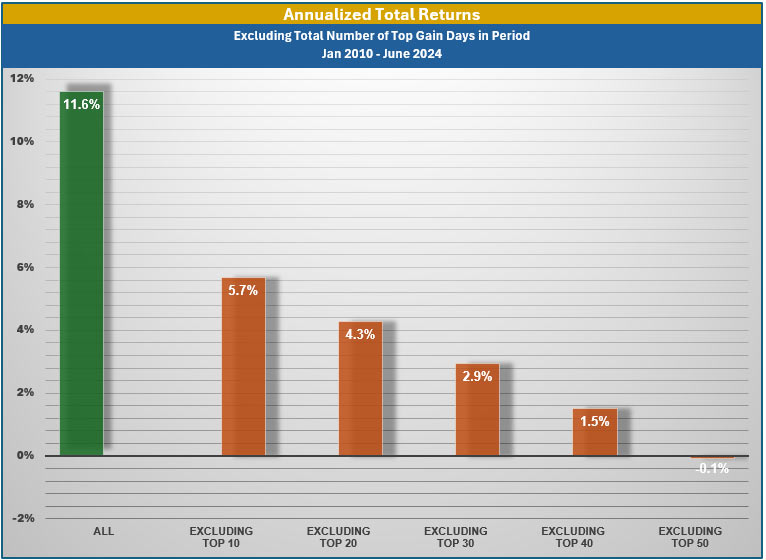
EXHIBIT 1
The Psychology of Market Timing
Many investors attempt to time the market, selling out of fear during downturns and re-entering when conditions seem more favorable. However, this strategy is fraught with challenges. Market timing requires not just one correct decision, but two: knowing when to exit and when to re-enter. Historically, even professional investors have struggled to consistently make these calls accurately.
The Dalbar Study, a widely cited report on investor behavior, has consistently shown that the average investor underperforms the market significantly due to poor timing decisions. Over the 20-year period ending in 2020, the S&P 500 returned an average of 7.47% annually, while the average equity fund investor earned only 5.96% annually, largely due to mistimed exits and entries.
The Cost of Missing Out
To understand the cost of missing out on the best part of a recovery, let’s examine five recent recoveries in the S&P 500 and the potential impact on investors who were not fully invested during these critical periods.
Summary of missed opportunities:
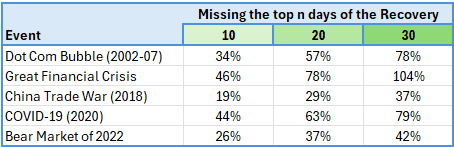
EXHIBIT 2 (Source: S&P 500 daily returns, Factset)

1. The Dot-Com Bubble Recovery (2002-2007)
The early 2000s were marked by the bursting of the dot-com bubble, which saw the S&P 500 plummet by nearly 50% from its peak in March 2000 to its trough in October 2002. The recovery that followed was robust, with the S&P 500 increasing by approximately 100% from the bottom in 2002 to the end of 2007.
Impact of Missing the Initial Phase: An investor who re-entered the market in late 2003 would have missed the initial gains. Assuming a $10,000 investment made at the bottom in 2002, by the end of 2003, the investment would have doubled to $20,000. If they missed this surge and waited until 2004, they would have only captured a fraction of that growth, significantly reducing their potential gains.
Cost of missing the 10 best days: 34%
2. The Global Financial Crisis Recovery (2009-2014)
The financial crisis of 2007-2008 led to one of the most severe market downturns in history. The S&P 500 fell by more than 50% from its peak in October 2007 to its bottom in March 2009. The subsequent recovery was swift and strong, with the index doubling from its March 2009 low by the end of 2014.
Impact of Missing the Initial Phase: Investors who stayed out of the market until 2011 missed the first two years of recovery, during which the S&P 500 gained approximately 80%. A $10,000 investment made at the market bottom in March 2009 would have grown to about $18,000 by the end of 2011. Missing this recovery phase means missing out on substantial growth, leaving investors significantly behind.
Cost of missing the 10 best days: 46%
3. The U.S.-China Trade War Recovery (2018)
In late 2018, the S&P 500 experienced a significant decline due to fears surrounding the U.S.-China trade war, dropping nearly 20% from its peak in September to its trough in December. However, by early 2019, the market began to recover, with the S&P 500 rising more than 25% from its December low to July 2019.
Impact of Missing the Initial Phase: An investor who waited until after the market had already started to recover in January 2019 would have missed out on the initial gains. If they had invested $10,000 at the market bottom in December 2018, they would have seen their investment grow to approximately $12,500 by July 2019, illustrating the cost of missing that recovery.
Cost of missing the 10 best days: 19%
4. The COVID-19 Pandemic Recovery (2020-2021)
The COVID-19 pandemic caused a sharp and rapid market downturn in early 2020, with the S&P 500 falling by over 30% in just a few weeks. The recovery, however, was equally swift, with the S&P 500 gaining more than 60% from its March 2020 lows to the end of 2020.
Impact of Missing the Initial Phase: Investors who re-entered the market late in 2020 missed a 60% rebound. A $10,000 investment made at the market bottom in March 2020 would have grown to approximately $16,000 by year-end. Missing this recovery phase represented a substantial opportunity cost for those who waited to invest.
Cost of missing the 10 best days: 44%
5. The Bear Market Recovery of 2022
After the steep decline in the first half of 2022 due to rising interest rates and inflation concerns, the S&P 500 saw a significant recovery starting in mid-2022. By the end of the year, the market had rebounded by approximately 25% from its mid-year lows.
Impact of Missing the Initial Phase: Investors who delayed re-entering the market after the initial recovery began would have missed out on this substantial gain. A $10,000 investment at the market low in June 2022 would have grown to around $12,500 by December 2022. This scenario highlights the importance of being present in the market, even amid uncertainty.
Cost of missing the 10 best days: 26%
The Long-Term Impact of Missing Recoveries
The examples above illustrate the immediate impact of missing the initial phase of market recoveries, but the long-term consequences can be even more significant. Compounding–the process by which investment gains generate their own gains over time–means that early losses or missed opportunities can have a snowball effect on future returns.
Example of Long-Term Impact
Consider an investor who misses the initial 50% rebound following a market downturn. If the market continues to grow at an average annual rate of 7% thereafter, the impact of missing the early gains can compound significantly over time.
- Scenario 1: Fully Invested
- Initial Investment: $10,000
- Initial Rebound: 50% → $15,000
- Subsequent Annual Growth: 7%
- Value After 10 Years: $15,000 * (1.07^10) ≈ $29,508
- Scenario 2: Missed Initial Rebound
- Initial Investment: $10,000
- Subsequent Annual Growth: 7%
- Value After 10 Years: $10,000 * (1.07^10) ≈ $19,671
Missing the initial 50% rebound results in a portfolio worth approximately $9,837 less after 10 years, highlighting the importance of staying invested.
Strategies to Avoid Missing the Recovery
 Given the potential costs, what can investors do to avoid missing the best part of market recoveries?
1. Stay Invested
One of the simplest strategies is to remain invested through market downturns. While this can be psychologically challenging, history shows that markets tend to recover over time.
2. Dollar-Cost Averaging
Dollar-cost averaging involves investing a fixed amount of money at regular intervals, regardless of market conditions. This strategy reduces the risk of mistiming the market and ensures that investors buy more shares when prices are low and fewer shares when prices are high.
3. Diversification
Diversifying across asset classes, sectors, and geographies can help mitigate the impact of downturns in any single area. While diversification doesn’t eliminate risk, it can reduce volatility and help smooth out returns over time.
4. Rebalancing
Regularly rebalancing a portfolio ensures that it remains aligned with the investor’s risk tolerance and goals. During downturns, rebalancing may involve buying more of the underperforming assets, positioning the portfolio to benefit from subsequent recoveries.
Conclusion
Missing the best part of a market recovery can have significant and lasting impacts on an investor’s portfolio. The initial phase of recoveries often delivers substantial gains, and staying invested through market cycles is crucial for capturing these opportunities. By understanding the potential costs and adopting strategies to remain invested, investors can better navigate market volatility and position themselves for long-term success.
Investors should focus on maintaining a disciplined approach, leveraging strategies such as dollar-cost averaging and diversification, and avoiding the temptation to time the market. By doing so, they can ensure they are well-positioned to benefit from market recoveries and achieve their financial goals.
Sources:
Dalbar Quantitative Analysis of Investor Behavior (QAIB). Dalbar, Inc. (2021).
Historical data on the S&P 500 from various financial databases.
Related Articles

How Quality of the Portfolio Impacts Down Market Recovery and Compounding
Investment Principles,
Top Investment Principles FAQs,
January 15, 2025
Waiting for Recovery Instead of Chasing Returns
Investment Principles,
January 8, 2025

Building a portfolio with a correction in mind vs timing the correction
Investment Principles,
Markets,
Portfolio Considerations,
October 1, 2024