


Not all indexes are constructed equally. Two primary approaches are market-cap-weighted indexes and equal-weighted indexes, each offering distinct characteristics, risks, and potential returns.
Historically, the equal-weighted S&P 500 Index has outperformed the market-cap weighted S&P 500 index, but each has their time in the sun:
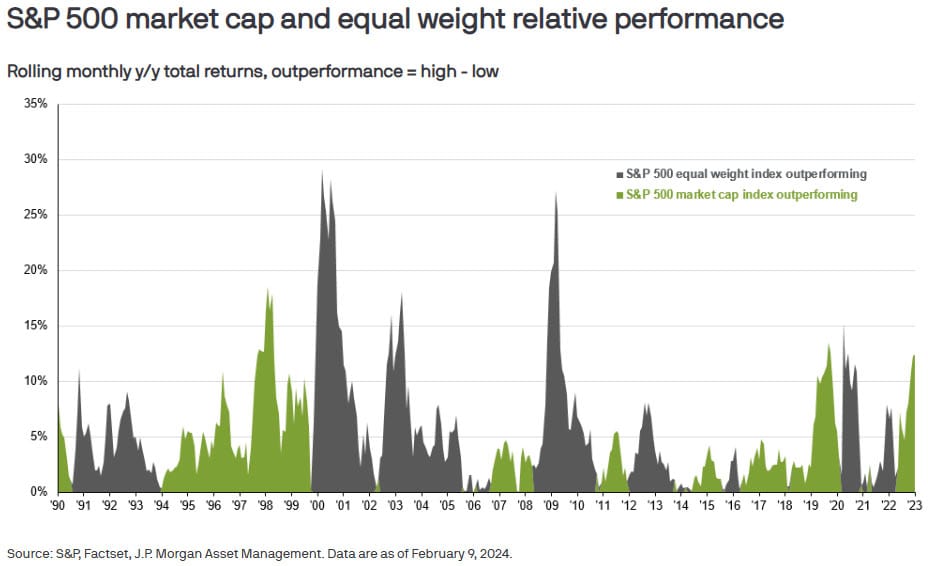
(an index is unmanaged, and you cannot directly invest in an index)
You may notice that the equal-weighted index often performs better during down markets. This can be seen after the bursting of the dot-com bubble in 2000, and in the wake of the ’07-’08 financial crisis.
While it is important to understand the differences between a market-cap and equal-weighted index, investors should avoid thinking that the grass is greener on the other side. We believe that pursuing a balanced, long-term strategy is the way to build lasting wealth.
Market-Cap-Weighted Indexes
Market-cap-weighted indexes allocate a higher percentage to companies with larger market capitalizations. The index’s value reflects the combined value of each company’s shares outstanding multiplied by the share price, assigning more weight to bigger companies.
Popular market-cap-weighted indexes include the S&P 500, the Nasdaq Composite, and the MSCI World Index. These indexes are heavily influenced by the largest constituents in their universe, which tends to be large-cap or mega-cap companies.
Characteristics
- Concentration: Market-cap weighting often results in higher exposure to a few dominant players. For instance, as of October 2024 the top 6 constituents of the S&P 500 are Apple, Nvidia, Microsoft, Amazon, Meta, and Alphabet Class A. Together these six companies make up over 27% of the S&P Index. You might notice that each of these companies is in the technology industry, meaning someone investing in an S&P 500 market-cap weighted index would have a significant concentration in technology stocks.
- Performance: Market-cap-weighted indexes excel when sectors or industries that are overrepresented in their index do well. For instance, the S&P 500’s concentration in technology stocks means that rallies in the tech sector will improve the index’s return. However, the inverse is also true. If tech suffers a pullback, the S&P 500 index returns will also decline.
- Lower Turnover: Since market-cap indexes self-adjust when stock prices change, turnover is often lower, translating to reduced transaction costs and tax efficiency for those pursuing an index investing strategy.
Equal-Weighted Indexes
Equal-weighted indexes assign the same weight to each constituent, regardless of its market capitalization. This method gives equal importance to all companies in an index, offering a more diversified exposure within the index’s scope.
An equal-weighted version of the S&P 500, for example, assigns 0.2% to each of the 500 companies, rather than weighting by company size. Other equal-weighted indexes exist across sectors, asset classes, and geographical regions.
Characteristics
- Less Concentration Risk: Equal weighting results in broader exposure across all constituents, mitigating the concentration risk of market-cap-weighted indexes. Using the six companies mentioned earlier as an example, in an equal-weighted S&P 500 index they would only comprise 1.2% of the total. The equal-weighted index is generally less sensitive to changes in a single company or sector’s value.
- Performance: By granting more representation to the smaller constituents of an index, equal-weighted indexes can experience more of the upside when these stocks do well. On the other hand, equal-weighted indexes may underperform when the largest companies of the index are rallying.
- Higher Turnover: Equal-weighted indexes require periodic rebalancing to maintain equal weighting, which can lead to higher transaction costs and potential tax implications.
Key Takeaways
Market-cap-weighted indexes concentrate more on larger companies, while equal-weighted indexes provide broader, diversified exposure across all constituents. When a small group of stocks are performing well, market-cap weighting tends to outperform. The inverse is also true, if many of the largest companies begin to stumble, the equal-weighted S&P 500 shows its strength. Understanding how these index approaches differ gives index investors a better understanding of their portfolio and its results.
Related Articles

Exploring the Different Forms of Index Investing: Mutual Funds, ETFs, and Institutional Indexing
Index Investing,
Top Index FAQs,
Types of Indexes,
September 24, 2024

How do market cap index funds work?
Index Investing,
Top Index FAQs,
Types of Indexes,
October 24, 2023

Comparing the Tax Efficiency of Mutual Funds, ETFs, and Institutional Money Managers. Which should you choose?
Index Investing,
Indexing for the Affluent,
Personal Finance,
Top Personal Finance FAQs,
September 17, 2024